Duodenal and biliary stents
Stents are used to treat symptoms caused by pancreatic cancer (1).
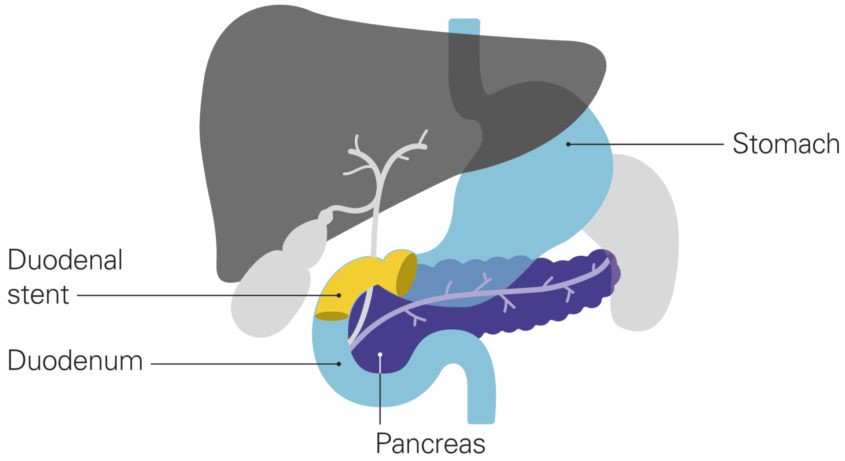
A stent can be put into the bile duct (biliary stent) or duodenum (duodenal stent) to unblock them (1,2). Sometimes stents may need to be put into both the bile duct and the duodenum (2,3).
Biliary stents
Patients may have a biliary stent put in:
- to treat the jaundice if the cancer is inoperable, as recommended by NICE guidance (1,2,4),
- to help relieve the jaundice if their cancer can be removed by surgery but they’re not currently well enough to have the operation, as recommended by NICE guidance (1),
- to treat the jaundice if they’re having chemotherapy before surgery.
Biliary stents are usually put in during endoscopic retrograde cholangio-pancreatography (ERCP) (5-7). Where this is not possible, they may have a percutaneous transhepatic cholangiogram (PTC) (4,8) where the stent is passed through the abdominal wall and liver, and into the bile duct, using a thin needle and fine guide wire.
Any symptoms of jaundice usually improve in the first couple of days but may take two to three weeks to go completely (4,9).

| NICE guidelines recommend offering endoscopically placed self‑expanding metal stents for patients who need biliary drainage and have resectable pancreatic cancer and obstructive jaundice but are not fit enough for resectional surgery yet (1). |
Duodenal stents
Patients may have a duodenal stent put in to treat their symptoms if the cancer is inoperable (1,2,4).
Duodenal stents to treat gastric outlet obstruction should stop patients vomiting and they should start to feel like eating again (1,2).
It involves passing an endoscope through the mouth and down into the duodenum, then a fine wire is used to guide the stent into place inside the duodenum.
Patients should start to feel better quickly, usually within a couple of days (4,10,11).
Main problems with stents
- Blockages – usually caused by the cancer growing through the stent, or a build-up of bile/biliary sludge/debris in a biliary stent (4). With a duodenal stent, food can block the stent such as, vegetable skin and stalks, raw or stringy vegetables, fruit skin, pips and seeds, pithy fruit, dried fruit, nuts, and seeds, popcorn, fish with bones, gristly/tough meat, high fibre cereals and crusty bread. The stent may need to be replaced, often after three or four months (10-13).
- Infections (4) – usually caused by the stent getting blocked.
- Stent migration (4,11-13)
- Inflamed pancreas – sometimes an ERCP for a biliary stent can cause pancreatitis
- Discomfort
Information for your patients
- Fact sheet: Stents to treat jaundice caused by a blocked bile duct
- Fact sheet: Stent for a blocked duodenum